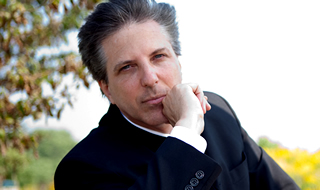
MARCO PARISOTTO • biography
Born in Montreal of Italian lineage, Marco Parisotto is among Canada's foremost conductors on the international scene. A guest with orchestras around the globe, with unrelentingly high standards of performance, he continues to thrill audiences with his passionate musicmaking. He is the winner of seven major international competitions and crowned these achievements at the 1997 “Besançon International Competition for Conductors”, being awarded both the Grand Prix as well as the Prix du Public - a historical first at this elite event.
Marco Parisotto’s close association with orchestras is manifested through the strong relationships he has maintained with ensembles under his leadership. As Artistic Director of the Ontario Philharmonic in Canada, a title he has held for over two decades, he has earned praise for the orchestra’s development and adventurous performances. In 2013, he was unanimously elected as Music Director of the Jalisco Philharmonic, transforming this ensemble into one of Latin America’s most distinguished orchestras. Under his direction, the Jalisco Philharmonic garnered international attention with its virtuosic performances and participated in recordings, tours, international festivals and major events such as Operalia, The World Opera Competition. During his tenure, the orchestra undertook major concert tours eliciting great critical and public acclaim as they visited Germany, Austria, the USA and Mexico in leading concert halls of Berlin, Munich, Essen, Vienna, Los Angeles, San Francisco, Busan and Mexico City. As well, through Maestro Parisotto, the orchestra completed significant commercial recording projects, starting with the Philharmonic’s first release under the SONY Classical label.
“Amidst this exciting pillar of sound growing constantly, stands Marco Parisotto. Under his control, directing the orchestra with the greatest finesse, like an architect he gives precise instructions that develop into a majestic edifice of sound… He ingeniously manages the full spectrum of colors of his orchestra… We hope that this fantastic orchestra with this dynamic conductor will visit our German concert halls more frequently, bringing with them their style of spicy and fiery music-making.” • Klassik Begeistert, Raphael Eckardt.
Following aspecial concert celebrating Canada-China relations in 1999 at the Grand Theatre in Shanghai, Marco Parisotto was appointed Principal Conductor and Artistic Advisor of the Shanghai Symphony Orchestra, a position he held until 2003.
Since 1996, he has been recognized as the visionary Music Director of the Ontario Philharmonicin Canada, credited with meticulously cultivating the orchestra to world-class standards. Under his leadership, the orchestra has received superlative audience and media recognition.
“…a fantastic orchestra [OntarioPhilharmonic] being led by a first-rate conductor” •Musical Toronto (Ludwig van Toronto)
During the 2023–2024 season, Marco Parisotto was invited by the Neue Philharmonie Hamburg to celebrate its 20th anniversary with a series of concerts and tours across Germany's major concert halls. He maintains a close relationship with this young orchestra whose presence continues to enrich Hamburg's musical landscape and draws enthusiastic audiences.
Marco Parisotto has won critical and public praise for his interpretations of the great Austro-German repertoire - as R.Strauss, Bruckner, Wagner, and as an avid Mahlerian. He has also been acclaimed for his readings of Russian masters as Tchaikovsky, Shostakovich, Stravinsky, and for his passionate performances in the operatic field. He has led productions including, among others, Pagliacci, Cavalleria Rusticana, Carmen, Otello, Madama Butterfly, Tosca, La Boheme, Aida, Rigoletto, Don Giovanni and Turandot.
“The star of the evening was without a doubt Marco Parisotto…inspired,passionate and in a virtual state of grace, impressing a supreme flow and agility to this extremelychallenging opera [Puccini’s Turandot].” • Opera World
Marco Parisotto has appeared in major concert halls throughout the world, conducting many leading orchestras including the Orchestre symphonique de Montréal, Philharmonia Orchestra of London, Orchestra Sinfonica di Milano "LaVerdi", Orchestra Haydn di Bolzano, New Jersey Symphony, Toronto Symphony, Calgary Philharmonic, Edmonton Symphony, Vancouver Symphony, National Arts Center Orchestra in Ottawa, Orchestre symphonique de Québec, Orquesta Filarmónica de Bogotá, Busan Philharmonic, Osaka Philharmonic, Tokyo Symphony, Tokyo Philharmonic, Seoul Philharmonic, Louisiana Philharmonic, Erfurt Philharmonic, Philharmonisches Orchester Altenburg Gera, Belgrade Philharmonic, Georges Enescu Philharmonic, Janacek Philharmonic, Orchestre National de France, Orchestre National du Capitole de Toulouse, Opéra de Bordeaux, Opéra de Marseille, Orchestre Philharmonique de Strasbourg and Philharmonique de Liège. He was received with great enthusiasm at the international Festivals of Evian, Menton, Besançon, Festival Cervantino, Wieniawski International Festival (Poland), May Festival of Guadalajara, Festival of Opera in Jalisco, Skaneateles Festival New York, Busan Maru International Music Festival and Bolzano Festival; at the Yerevan International Music Festival with the Armenian National Philharmonic, Armenian State Symphony; at the Montreal Opera, Shanghai Opera, Opera Giuseppe Verdi di Trieste, Serbian National Theatre; in Mexico with the Mexico City Philharmonic, Orquesta Filarmonica de la UNAM, Orquesta Sinfonica Sinaloa de las Artes, Orquesta Sinfonica de UANL, Camerata de Coahuila, Sinfonica Carlos Chavez, Camara de Bellas Artes, Orquesta de Baja California; in China with the Shanghai Symphony, China National Symphony, Wuxi Symphony, Qingdao Symphony, Wuhan Philharmonic and Gui Yang Symphony. He has also led to acclaim the Polish National Radio Symphony, Monte-Carlo Philharmonic, Orchestra Nazionale della RAI of Torino, Orquesta de Cordoba, Orchestre de Bayonne Côte-Basque. On several occasions, he was a guest of Orchestre des Concerts Lamoureux in Paris.
He hasperformed in major venues such as the Barbican, Konzerthaus Berlin and Vienna, Gasteig, Elbphilharmonie, Philharmonie Berlin, Leipzig Gewandhaus, Théâtre des Champs-Élysées, Davies Symphony Hall, China National Center for the Performing Arts.
Marco Parisotto is the winner of seven important international competitions. Aside from his noteworthy awards at the prestigious Besançon Competition, joining the ranks of maestros like Seiji Ozawa and Michel Plasson, other top prizes have included the Tokyo International Conductors' Competition in Japan, Constantin Silvestri Competition in Romania and the Antonio Pedrotti in Italy. He was moreover honored with all other special awards at these events.
He took his training both as a violinist and pianist and studied conducting with eminent maestros including Leonard Bernstein. Carlo Maria Giulini, Leonard Slatkin, Charles Brück, Yuri Temirkanov, Georg Tintner and, initially, with Raffi Armenian at the Conservatoire de Musique du Québec in Montreal.
IN A FEW WORDS • A SELECTION OF CONCERT REVIEWS
• The star of the evening was without a doubt Marco Parisotto…inspired, passionate and in a virtual state of grace, impressing a supreme flow and agility to this extremely challenging opera [Puccini’s Turandot]. From the very first notes, the music made a vehement, vigorous and emotional statement emanating from the masterly baton of an illuminated being. The communication between Parisotto and his instrument was impressive. Great triumph! [Opera Festival with Jalisco Philharmonic]
Opera World
• Place des Arts’ Wilfrid-Pelletier Hall is full, Marco Parisotto steps on to the podium and the enchantment commences... What a musician! Under his baton, Haydn found all the verve and humour one could hope for...he made the Orchestre symphonique de Montréal sound like a marvel. ...In Francesca da Rimini Marco Parisotto’s formidable musical power radiated, revealing the mastery of this score to the audience. The infernal and menacing dissonances, the demonic syncopations, all were rendered with a fearsome energy and evocative force which literally left one shaking... To hear him efficiently animate this sonic canvas with all its warmor harsh colours was electrifying... What a performance! Better yet, this is the signature of an artist who stands among the greatest.
Le Devoir
• In my long career I've heard Th eRite of Spring at least 50 times with most of the major orchestras and conductors. Starting with Pierre Monteux[...] Karajan, Boulez, Bernstein[...] Well! Marco Parisotto held me spellbound from one end to the other. He succeeded in realizing a performance that was masterful both musically and technically...It was indeed a commanding Rite... [with Ottawa Symphony Orchestra]
Le Droit
• ...Marco Parisotto could take on the world... I heard Parisotto lead this ensemble [Ontario Philharmonic] last Saturday at Koerner Hall. To say I was surprised is putting it mildly. Everything about Parisotto's exacting and fluid style on the podium suggested a major international talent.
Montreal Gazette
• Outstanding…! Parisotto´s [presence on the podium] confirmed that his recent appointment as MusicDirector of the Jalisco Philharmonic was the perfect decision, and that the ensemble has achieved an extraordinary sound: the best, perhaps, in the last 50 years.
El Informador
• Amidst this exciting pillar of sound growing constantly, stands Marco Parisotto. Under his control, directing the orchestra with the greatest finesse, like an architect he gives precise instructions that develop into a majestic edifice of sound… He ingeniously manages the full spectrum of colors of his orchestra [Jalisco Philharmonic]… This conductor demonstrates…all the spectrum of this wonderful Art... We hope that this fantastic orchestra with this dynamic conductor will visit our German concert halls more frequently, bringing with them their style of spicy and fiery music-making.
KlassikBegeistert, Raphael Eckardt
• This young conductor belongs to the greatest. Not since the debuts of Chailly and Rattle have I been so impressed. [withNational Arts Centre Orchestra]
Le Droit
• Marco Parisotto’s very dynamicconducting clearly stimulates the musicians and inspires the audience. Hisinnate sense of rhythm was manifested right from the start of the Glinka[Ruslan and Ludmila] beginning the concert with striking effect... Swan Lakewas tackled with such voluptuousness and drama that one got the impression thatthe actual ballet was emerging right before ones eyes. [withOrchestre symphonique de Montréal]
La Presse
• …Another 150 th Anniversary resulted in the best symphonic concert of 2014 [in all of Mexico] and it was the homage to Richard Strauss with which the Orquesta Filarmonica de Jalisco closed its annual season. With imagination and determination, Marco Parisotto has brought the orchestra to an astounding level of excellence.
Reforma
• I can't even begin to count the number of recordings of the work [Petrushka] I've heard, but nothing came even close to the transparency and vivid coloration of conductor Marco Parisotto's and the orchestra's collaboration. [withNew Jersey Symphony Orchestra]
Classical New Jersey Society
• Performing at Mexico City’s Bellas Artes Palace with an all-Beethoven program, the Orquesta Filarmonica de Jalisco and Music Director, Maestro Marco Parisotto gave a lesson in how an orchestra should sound. Withouta doubt this is the indisputable merit of the Maestro Parisotto… With certainty, I can state that the Jalisco audience should not only feel proud of its orchestra but also claim it as the leading orchestra of our nation… And all of this thanks to Maestro Marco Parisotto who has placed his musicians on a pedestal that perhaps not even they had ever dreamt of.
Critica Musical En Mexico
• Marco Parisotto, a young and already great conductor... He gave a concert which the audience will never forget... The orchestra was electrified... The phrasing was so highly expressive and the tempi led with such dizzying vigour that the audience was left in a stupor... A concert that will doubtless remain as one of this city’s most memorable artistic events. [withOrchestre de Bayonne Côte-Basque]
Sud-Ouest
• …both soloists [Igor and Valeri Oistrakh] were greatly assisted by extremely supportive playing from the Philharmonia Orchestra under Marco Parisotto.”
The Strad
• The orchestra's role was realized by an exceptional conductor, Marco Parisotto, who managed to bring the orchestra out of the pit… and made it a protagonist on stage. His role in putting together all the different elements of the performance [Mozart’s Don Giovanni at Serbian National Opera] was extraordinary.
Politika, Belgrade
• This work [Mahler’s 5th Symphony] requires a brilliant orchestra and an exceptional baton. From the podium, Marco Parisotto’s performance was out of this world. His was a profound rendition. His masterly approach of sound and intensity at every moment projected his deep understanding of the score to the ensemble and audience, which celebrated the evening with a monster ovation. [withJalisco Philharmonic]
El Informador
• The standing ovation that followed [Mahler’s 2ndSymphony] was one of the most prolonged and enthusiastic that the Jalisco Philharmonic has ever enjoyed at Teatro Degollado… Marco Parisotto’s use of the baton was as though a paintbrush tracing a harmonic mosaic.
El Informador
• The performance [with Orchestre symphonique de Montréal] was remarkable. The symphony [Schumann 2nd] had a dramatic intensity and an aura of anguish which was aptly Schumannesque. The Scherzo was lively and sparkling, the Adagio sublimely expressive and the clearly defined tempo and balance in the Finale allowed for admirable control of all its contrapuntal intricacies. The audience responded with a monster ovation.”
La Presse