JAEDEN IZIK-DZURKO • biography
“In a world of competition, hype and promotion, Jaeden Izik-Dzurko stands apart. He is a sincere artist and deserves our attention”. (Bachtrack)
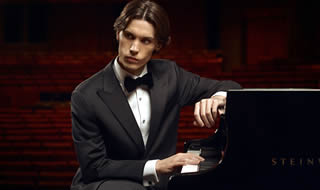
Canadian pianist Jaeden Izik-Dzurko is the 2024 Gold Medal winner of the Leeds International Piano Competition and a current recipient of the prestigious Borletti-Buitoni Trust Fellowship. That same year he took gold in Leeds, Jaeden made history as the first Canadian to receive the Grand Prize at the Concours Musical International de Montréal.
The 2025/26 season features high profile debut performances at London’s Wigmore Hall, San Francisco’s Davies Symphony Hall, the Leipzig Gewandhaus (Mendelssohn-Saal), and Hamburg’s Elbphilharmonie. Jaeden will also make his debut as soloist with both the Orchestre Symphonique de Montréal and the National Symphony Orchestra of Ireland, and makes returns to the Kamloops Symphony Orchestra, Edmonton Symphony Orchestra, and the National Arts Centre Orchestra. His repertoire this season includes works by Chopin, Brahms, Grieg, and Rachmaninoff, with collaborations alongside conductors Jessica Cottis, Gemma New and Alexander Shelley.
Jaeden has performed solo recitals at leading international venues, such as Carnegie Hall’s Weill Recital Hall, Salle Cortot in Paris, and the Auditorio Nacional de Música in Madrid. Other notable engagements include performances with the Vancouver Recital Society, Münchner Künstlerhaus, and Sociedad Filarmónica de Bilbao. His orchestral highlights include appearances with the Orchestre Symphonique de Montréal, Bilbao Orkestra Sinfonikoa, and the RTVE Symphony Orchestra, under the direction of Domingo Hindoyan, John Storgårds, and Joseph Swensen.
Jaeden has earned top prizes at the Hilton Head, Maria Canals, and Paloma O’Shea Santander International Piano Competitions, where he was also awarded the Canon Audience Prize and Chamber Music Award.
Born in British Columbia with Hungarian-Ukrainian heritage, Jaeden studied under Dr. Corey Hamm at the University of British Columbia before pursuing further studies at the prestigious Juilliard School. He currently trains with Jacob Leuschner at the Hochschule für Musik Detmold and Benedetto Lupo at the Accademia Nazionale di Santa Cecilia.

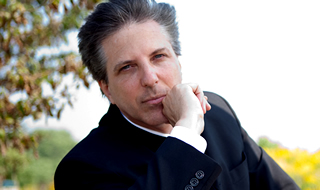
MARCO PARISOTTO • biography
Born in Montreal of Italian lineage, Marco Parisotto is among Canada's foremost conductors on the international scene. A guest with orchestras around the globe, with unrelentingly high standards of performance, he continues to thrill audiences with his passionate music making. He is the winner of seven major international competitions and crowned these achievements at the1997 “Besançon International Competition for Conductors”, being awarded both the Grand Prix as well as the Prix du Public - a historical first at this elite event.
As Artistic Director of the Ontario Philharmonic (OP), a title he has held for over two decades, he has earned praise for the orchestra’s development and adventurous performances, and he is credited with building OP to the high standard it enjoys today. Under his leadership, Ontario Philharmonic has received superlative audience and media recognition.
“…a fantastic orchestra [Ontario Philharmonic] being led by a first-rate conductor” • Musical Toronto.
Marco Parisotto’s close association with orchestras is manifested through the strong relationships he has maintained with ensembles under his leadership. In 2013, he was unanimously elected as Music Director of the Jalisco Philharmonic, transforming this ensemble into one of Latin America’s most distinguished orchestras. Under his direction, the Jalisco Philharmonic garnered international attention with its virtuosic performances and participated in recordings, tours, international festivals and major events such as Operalia, The World Opera Competition. During his tenure, the orchestra undertook major concert tours eliciting great critical and public acclaim as they visited Germany, Austria, the USA and Mexico in leading concert halls of Berlin, Munich, Essen, Vienna, Los Angeles, San Francisco, Busan and Mexico City. As well, through Maestro Parisotto, the orchestra completed significant commercial recording projects, starting with the Philharmonic’s first release under the SONY Classical label.
“Amidst this exciting pillar of sound growing constantly, stands Marco Parisotto. Under his control, directing the orchestra with the greatest finesse, like an architect he gives precise instructions that develop into a majestic edifice of sound… He ingeniously manages the full spectrum of colors of his orchestra… We hope that this fantastic orchestra with this dynamic conductor will visit our German concert halls more frequently, bringing with them their style of spicy and fiery music-making.” • Klassik Begeistert, Raphael Eckardt
Following a special concert celebrating Canada-China relations in 1999 at the Grand Theatre in Shanghai, Marco Parisotto was appointed Principal Conductor and Artistic Advisor of the Shanghai Symphony Orchestra, a position he held until 2003.
Marco Parisotto has won critical and public praise for his interpretations of the great Austro-German repertoire - as R. Strauss, Bruckner, Wagner, and as an avid Mahlerian. He has also been acclaimed for his readings of Russian masters as Tchaikovsky, Shostakovich, Stravinsky, and for his passionate performances in the operatic field. He has led productions including, among others, Pagliacci, Cavalleria Rusticana, Carmen, Otello, Madama Butterfly, Tosca, La Boheme, Aida, Rigoletto, Don Giovanni and Turandot.
“The star of the evening was without a doubt Marco Parisotto…inspired, passionate and in a virtual state of grace, impressing a supreme flow and agility to this extremely challenging opera [Puccini’s Turandot].” • Opera World.
Marco Parisotto has appeared in major concert halls throughout the world, conducting many leading orchestras including the Orchestre symphonique de Montréal, Philharmonia Orchestra of London, Orchestra Sinfonica di Milano "La Verdi", Orchestra Haydn di Bolzano, New Jersey Symphony, Toronto Symphony, Calgary Philharmonic, Edmonton Symphony, Vancouver Symphony, National Arts Center Orchestra in Ottawa, Orchestre symphonique de Québec, Orquesta Filarmónica de Bogotá, Busan Philharmonic, Osaka Philharmonic, Tokyo Symphony, Tokyo Philharmonic, Seoul Philharmonic, Louisiana Philharmonic, Erfurt Philharmonic, Belgrade Philharmonic, Georges Enescu Philharmonic, Janacek Philharmonic, Orchestre National de France, Orchestre National du Capitole de Toulouse, Opéra de Bordeaux, Opéra de Marseille, Orchestre Philharmonique de Strasbourg and Philharmonique de Liège. He was received with great enthusiasm at the international Festivals of Evian, Menton, Besançon, Festival Cervantino, Wieniawski International Festival (Poland), May Festival of Guadalajara, Festival of Opera in Jalisco, Skaneateles Festival New York, Busan Maru International Music Festival and Bolzano Festival; at the Montreal Opera, Shanghai Opera, Opera Giuseppe Verdi di Trieste, Serbian National Theatre; in Mexico with the Mexico City Philharmonic, Orquesta Filarmonica de la UNAM, Orquesta Sinfonica Sinaloa de las Artes, Orquesta Sinfonica de UANL, Camerata de Coahuila, Sinfonica Carlos Chavez, Camara de Bellas Artes, Orquesta de Baja California; in China with the Shanghai Symphony, China National Symphony and Gui Yang Symphony. He has also led to acclaim the Polish National Radio Symphony, Monte-Carlo Philharmonic, Orchestra Nazionale della RAI of Torino, Orquesta de Cordoba, Orchestre de Bayonne Côte-Basque. On several occasions, at Théâtre des Champs Élysées in Paris, he was a guest of Orchestre des Concerts Lamoureux.
Marco Parisotto is the winner of seven important international competitions. Aside from his noteworthy awards at the prestigious Besançon Competition, joining the ranks of maestros like Seiji Ozawa and Michel Plasson, other top prizes have included the Tokyo International Conductors' Competition in Japan, Constantin Silvestri Competition in Romania and the Antonio Pedrotti in Italy. He was moreover honored with all other special awards at these events.
He took his training both as a violinist and pianist and studied conducting with eminent maestros including Leonard Bernstein, Carlo Maria Giulini, Leonard Slatkin, Charles Brück, Yuri Temirkanov, Georg Tintner and, initially, with Raffi Armenian at the Conservatoire de Musique du Québec in Montreal.